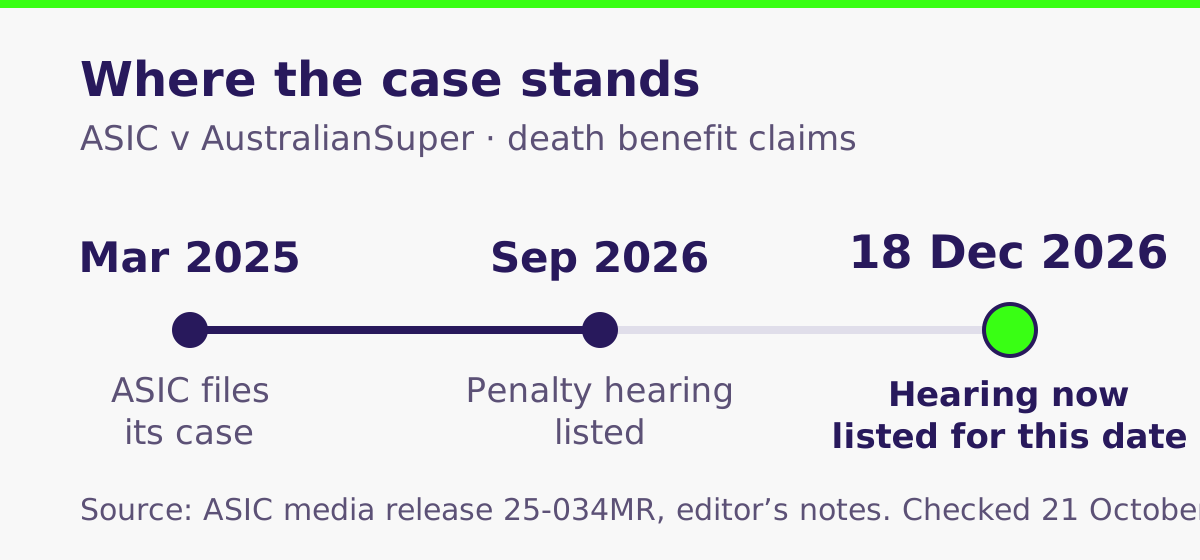
ASIC's Federal Court case over delayed death benefit claims at AustralianSuper has not concluded. The penalty hearing, once listed for 9 September 2026, has been adjourned to 18 December 2026.
At the same time, the fund says it has halved the time it takes to process death claims. For a family still waiting on a payment, neither fact answers the question that actually matters: where is our claim, and what is it waiting on? Here is what the public record says, and what you can ask.
The key numbers
Source: ASIC media release 25-034MR and its editor's notes. Figures describe ASIC's allegations as filed.
Where the case stands
ASIC began the proceeding in March 2025. It alleges that between 1 July 2019 and 18 October 2024, AustralianSuper failed to process at least 6,897 death benefit claims efficiently, honestly and fairly, and failed to pay benefits as soon as practicable in respect of at least 752 members. We covered the filing at the time in ASIC sues AustralianSuper over death benefit claim delays.
The timetable has moved repeatedly since. ASIC filed a Statement of Claim on 30 May 2025. Case management hearings listed for February, March and May 2026 were each vacated or adjourned. A penalty hearing was then listed for 9 September 2026 and, according to the latest editor's note on ASIC's release, has been adjourned to 18 December 2026.
What the release records is the listing and the adjournment. It does not announce a penalty outcome. We have deliberately not characterised where liability sits, because the release we checked does not state it — and ASIC notes that its media releases are point-in-time statements.
One AustralianSuper penalty has already been decided, and it is a different matter. On 21 February 2025 the Federal Court ordered the fund to pay a $27 million penalty for failing to merge members' duplicate accounts. That case concerned account administration, not death benefit claims. The detail is in AustralianSuper fined $27 million over duplicate accounts.
What AustralianSuper says has changed
In an update dated 20 August 2026, the fund said its in-house Bereavement Centre — established in May 2024 — employs 75 specialist case managers and gives each claim a dedicated case manager who oversees it from start to finish. It said it has halved the time taken to process death claims and that, as at June 2026, 80% of cases were resolved within four months of receiving the first claim.
The fund also notes a practical point worth knowing: once it is notified of a member's death, administration fees stop and the account is switched to cash.
These are the fund's own reported figures. They are not an independently verified result, and they do not set a deadline for any particular claim. AustralianSuper separately announced a compensation program for past death benefit delays in December 2024. If an earlier delay affected your family, you can ask the fund whether your claim was reviewed under that program and what the outcome was. Asking is not the same as being entitled to something — the answer is what tells you where you stand.
The wider picture: ASIC's progress review
In 2026 ASIC published Report 831, a progress review of 45 superannuation trustees following its earlier landmark review of death benefit claims handling. We covered the earlier report in ASIC's landmark report on death benefit claims.
The progress review found genuine improvement, including a 53% reduction in internal complaints about death benefit delays between early 2024 and late 2025. It also found that claims volumes rose 10% in the 12 months to October 2025, and that some trustees still had not made basic process improvements.
ASIC asked trustees to measure end-to-end claim times against real performance targets, take responsibility for how low-value and low-risk claims are handled, communicate proactively about steps that matter — such as making a valid binding death benefit nomination — and improve support for First Nations members and claimants. It also pointed ahead to the Commonwealth Government's proposed mandatory member service standards.
AustralianSuper is not the only fund under scrutiny. ASIC's separate action over death and TPD claim delays at Cbus is covered in Cbus fined $23.5 million over claim delays.
If your family is waiting
A death benefit can include the member's super balance and any insurance held in the account. The trustee has to establish who is entitled to receive it, and that is usually why timing varies: missing documents, competing claims and estate paperwork all affect how long it takes.
A short written request tends to work better than a phone call, because it creates a record. Four questions are usually enough:
- What stage has the claim reached?
- What information is still outstanding, and who is it needed from?
- What is the next step, and when should we expect an update?
- Can one person be our point of contact for this claim?
Keep the reply, together with copies of any forms and a simple note of calls and dates. It costs nothing and it is the thing that makes a later complaint straightforward.
If the answer does not resolve the concern, ask the fund for its formal complaints process. After that, the Australian Financial Complaints Authority (AFCA) provides free external dispute resolution and can consider superannuation complaints, including death benefit matters. If the dispute is about who receives the benefit, read the decision letter closely: particular eligibility rules and time limits apply to superannuation complaints, and some of them are short.
How ClaimSure can help
ClaimSure helps people work out what is actually held inside a super account, and what a fund or insurer is waiting on. We do not assess claims and we do not decide entitlements. What we can do is help you get a clear written picture of where things stand, and introduce you to a specialist firm where that is the right next step.
Not sure what your fund is waiting on?
Tell us about your situation and we'll help you work out what to ask, and who to ask. No obligation, plain English.
Get in touch →