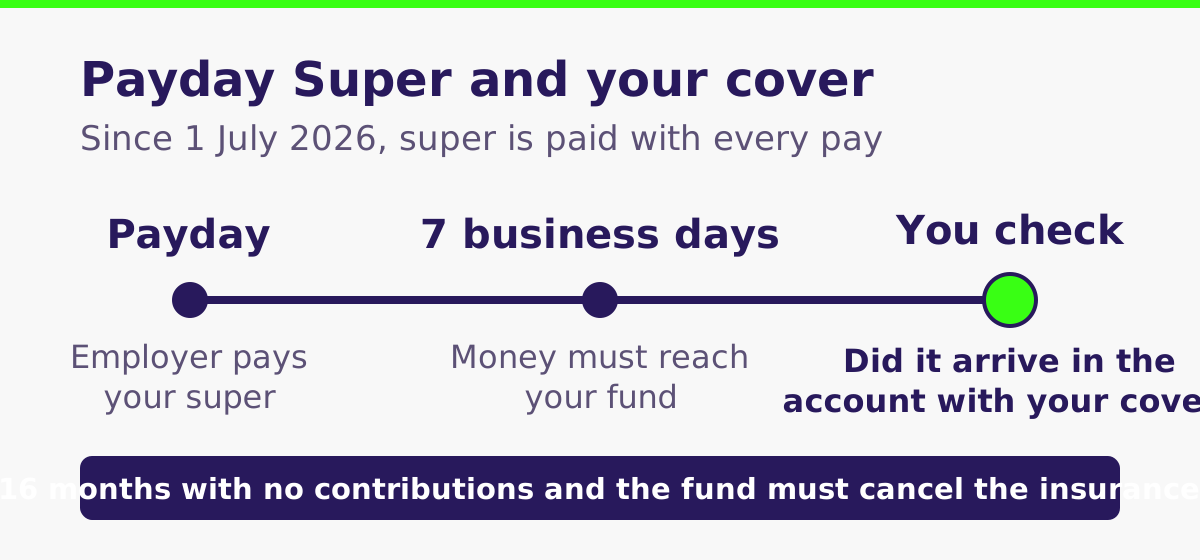
Since 1 July 2026, employers have to pay your super every time they pay you, not once a quarter. For most people that change happens quietly in the background.
But if you hold life, TPD or income protection insurance through your super, it matters. That cover usually stays switched on only while money keeps arriving in the account. Payday Super changes how often that money arrives, and it makes it far easier to check that it actually did.
The key numbers
Sources: ATO Payday Super guidance, Fair Work Ombudsman, Moneysmart.
What changed on 1 July
Until 30 June, employers could pay super up to 28 days after the end of each quarter. That meant your account might go three or four months without anything arriving, even while you were working full time.
Under Payday Super, the Superannuation Guarantee is paid each time you are paid. It generally has to reach your fund within 7 business days of payday. If you start a new job, the first payment can take up to 20 business days while your employer sets you up.
Employers now also report your earnings and the super they owe through Single Touch Payroll every pay. The ATO can match that against what your fund actually received, so missed payments should show up much sooner than they used to.
Why this matters for your insurance
Most super funds give members default life cover and TPD (total and permanent disability) cover, and some add income protection. The premiums come out of your super balance, and the cover is tied to that one account.
By law, a fund must cancel the insurance on an account that has received no contributions for at least 16 months, unless you have told the fund you want to keep it. Your fund has to contact you before the cover ends, but those letters and emails are easy to miss, especially if your contact details are out of date.
Two other rules are worth knowing. Cover does not start automatically for new members under 25, or while a new account balance is under $6,000, unless you ask for it. And if you already have cover and your balance later drops below $6,000, you usually keep it.
Who should pay attention
- Casual and seasonal workers. Gaps between jobs can add up. More frequent payments mean the gaps are easier to see.
- Anyone who has changed jobs. Your super normally follows you to the fund you already have. But if your insurance sits in an older account that no longer receives money, that account's 16-month clock is running.
- People who have stopped work through injury or illness. When the pay stops, so do the contributions. If you are on workers compensation, TAC or the Disability Support Pension, the account holding your cover may not be receiving anything at all.
- Anyone with more than one super account. You may be paying for cover twice, or the account you think is insured may be the one that has gone quiet.
If you have already stopped work because of an injury or illness, there is one more thing to know. Whether you can claim usually depends on the cover you held when you stopped work, not what the account holds today. So even if a fund later cancelled the cover, it is still worth finding out what was in place at the time.
A five-minute check
- Log in to your super account, or call the fund, and find the insurance section. Note what cover you hold, how much, and the premium.
- Compare your latest payslip with the account. Your super should appear within about a week of payday. If it has not, ask your employer first, then the ATO.
- Check every account you hold. Your myGov account, linked to the ATO, lists all your super accounts, including ones you have forgotten.
- Decide whether to keep cover on any quiet account. If the account holding your insurance has stopped receiving money, tell the fund in writing if you want to keep the cover, or arrange a contribution.
- Update your contact details so the fund's warning letters reach you.
Before you close or roll over an old account, check what insurance it holds. Closing it usually ends the cover, and new cover elsewhere may not start on the same terms.
How ClaimSure can help
Many people only find out what their super was insuring after they have stopped work. If that is you, a Free Claim Check takes about 15 minutes on the phone. We will help you work out which accounts you hold, what cover sits in them, and whether a claim is worth pursuing, and we put you in touch with the right person to take it forward.
Not sure what your super is insuring?
Tell us about your situation and we'll help you find out what cover you hold and what it could mean for you. Free, no obligation, plain English.
Start my Free Claim Check →